

The Urging Matter of Elephant Endangerment
This page is dedicated to my advocacy project on African Elephants and all the problems that they face. I will be presenting the final information I have researched on elephant cognition, intelligence, issues, and solutions for said issues. This will display the finished project that has been in the works for months.
Click here for the full Advocacy Project Essay and Works Cited
Background
For months now, a certain memory has been haunting me in the back of my mind. Back in 2017, I was oblivious and ignorant to the fact that both Asian and African elephants were an endangered species and proceeded to go on elephant rides in Thailand. Upon spending this quarter of the school year learning about animal science, it has come to my attention that what I did was detrimental to the species and that I had supported a business that held elephants in captivity and treated them inhumanely. When we are younger, we see things in a different light, more innocently, to be specific. Zoos are merely seen as an engaging activity and circuses are entertainment. However, as we grow older, certain activities become more awakening and they’re not as innocent as we had perceived them to be. African elephants have been declared as a “critically endangered” animal by the IUCN as of 2021, however, they have been considered an endangered species since 1978 according to the U.S. Fish and Wildlife Service. Elephants have been around for millions of years, nonetheless, it isn’t a coincidence that their population began to drop rapidly after humans came about.


According to Animal Cognition in Nature: The Convergence of Psychology and Biology in Laboratory and Field (1998), many scientists assumed that certain animal cognitive responses, such as memory or reactions to "stimuli," were "result[s] of simple processes" or impulses, rather than real knowledge of their environment (Balda et. al, vii). Yet, recent studies have shown that these elephants are not just animals that roam the earth, but they have a mind of their own and are more intelligent than imagined. These animals have been studied since the 1900s, as seen above, and every year more is learned about them. Three research cases that have been conducted throughout 2006-2010 reveal a plethora of information about their cognitive abilities.
Self-Recognition in Elephants
First and foremost, the 2010 study of elephants and self-recognition indicates that these animals are aware of themselves and they can distinguish between their individuality from their group’s. This subject was explored in the study of “Self-Recognition in the Asian Elephant and Future Directions for Cognitive Research with Elephants in Zoological Settings” by lead author, Joshua M. Plotnik, Ph.D., who is a professor at the City University of New York that dedicates his research to animal cognition and behavior. The study was conducted by a mirror self-recognition (MSR) test that had previously been performed on other animals such as chimpanzees (Gallup, 1970) and dolphins (Reiss and Marino, 2001), so this was not something new to observe.

The results of this study revealed elephants behaving with curiosity which differed from their typical day-to-day performance. When the animals were exposed to the mirrors, Plotnik et al. mentioned they would exhibit behaviors such as “rhythmic head movements” when they would move closer and farther from the mirror, examining their mouth by putting their trunk “in close proximity to the mirror”, and “eating right in front of the mirror” (186). The elephants’ success in passing the test was based on the scale of “increase in head touching” when placed in front of the mirror with the mark on their head. These simple actions indicate a sense of self-awareness since they are learning how their movements will be reflected and what they, themselves, look like to others. It isn’t to say that the elephants that didn’t pass the test are not aware of themselves, but perhaps they were more interested in their reflection rather than the mark on their head (Plotnik, 2010). Overall, this experiment contributes to the expanding knowledge of elephant cognition because it tests the basic ability of an animal to understand its existence and how they can differentiate themselves from other species or individuals within their group.
Memorization
Establishing the basic ability to recognize one’s self provides for a clearer understanding of how elephants can memorize the location of individuals within their herd and how this cognitive ability proves elephants to be more complex than imagined. The second study conducted in 2007 proved that elephants have amazing memory and tracking abilities. The study of African elephants’ memory is a core portion of cognition because it tests the ability of a species to look back on previous events and connect that to the present. This function was examined by lead researcher Lucy A. Bates, Ph.D., a researcher that focuses on ape and elephant behaviors, social interactions, and intelligence to help with her conservation efforts. The study, “African Elephants Have Expectations about the Locations of out-of-Sight Family Members”, was carried out by collecting samples of elephant urine of individuals within a group’s herd and other groups and placing them in a series of combinations, for example, collecting the urine sample of a group member who was behind a certain subject and relocating it to be in front of the tested subject (Bates et al.).

When presented with samples of urine “from individuals walking behind or from her absent family member” the elephant would exhibit more curiosity and confusion (Bates et al. 36). Such reactions were excessive sniffing of the sample, examination/tracking of the location of the family member, or reaching out to touch the sample. The confused reaction of the elephant indicates that they are capable of memorizing and tracking where each individual of their group is and this characteristic is vital to cognition. Bates and the other contributing authors also mentioned that since traveling causes the order of their members to constantly change, the “elephants must frequently update their expectation of where others are in locations to themselves” (36). This ability further supports the topic of how cognitively advanced elephants are, and even proves that these animals’ “recognition ability” is better than humans and other primates (Safina 37). The elephants must recall the previous location of their family member and apply this memory to the situation they are currently in, indicating that these species are aware of their surroundings. With this knowledge, it is alarming to see how humans have a history of exploiting elephants for their own benefit, despite the knowledge that they are an intelligent creature.
Causal Reasoning and Learning Abilities
Finally, the third study on elephant cognition goes into deeper detail about how elephants uniquely process information and their approach to problems. The study "Do Asian Elephants (Elephas maximus) apply causal reasoning to tool-use tasks?" is by a biology professor, Moti Nissani, Ph.D., on the topic of problem-solving and whether elephants can “apply causal reasoning” to situations (Nissani 91). Upon being given some food in a container that they could have directly reached in to grab, the elephants continued to demonstrate gestures of removing a lid and displacing the box before getting their treat. These gestures were what they learned in the pre-trial. They exhibited this behavior more often than not, throughout the study, which is a result of “functional fixedness” (Nissani 95). Although this specific experiment intended to determine whether elephants can comprehend the idea of cause and effect, the results provided more of a perspective on the learning abilities of elephants. The animals did not necessarily prove that they can apply the principles of causal reasoning, however, they displayed they can quickly learn how to mimic actions and what these actions would result in (Nissani 95). These behaviors provide insight into the complex topic of elephant cognition and intelligence because it displays how these animals’ minds process information through experiments and the way they apply these experiences in their life.


These sources force us to face the reality of how we, as humans, treat these animals. If they are aware enough to recognize their own existence (Plotnik et al., 2010) as well as memorize (Bates et al., 2007) and learn (Nissani, 2006), we must now ask the question, is keeping animals in captivity for entertainment and testing on them ethical? If animals are capable of these behaviors and beyond, it is completely reasonable to infer that they feel emotions such as loss or pain when we poach them for sport and trophies. The studies allow humans to understand these species on another level and lets us observe similarities that the human population and elephant population have in common; calling for better human-animal interaction. Throughout history, humans have killed elephants for their tusks and held them in captivity for zoos and entertainment. It is fair to say that these people were unaware of how animals can suffer, but science has now proven that they experience some of the same emotions as humans, and there is still mistreatment of elephants.
Morals and Ethics
The discussion of animal treatment brings up speciesism, a word created by philosopher Richard Ryder, which is the assumption that the human species is better and superior to that of animals rather than taking into account that all species are related (2012). This assumption has led to humans treating elephants as objects throughout history, causing many to become endangered. The reason people should care for elephants and their conservation is not only because they are intelligent and cognitively advanced but also because they are animals that can suffer, just like humans. When an elephant is held captive, their home is destroyed, or they are killed, how can humans disregard their suffering? Public speaker and animal rights activist, Gary Yourofsky, makes a point in one of his lectures stating how some people justify killing animals because they don’t think, reason, or talk like humans which is in a way like racism (2015). Carl Safina also points out a human behavior such that “[...] rather than mistakenly attributing emotions they do not experience, we have made a larger mistake by denying emotions that other animals do experience” (34). He expresses that just because elephants or animals, in general, do not communicate the same way humans do or they don’t feel the exact emotions that humans feel, does not disregard the fact that they can suffer. Upon exploring the ideas of consciousness and cognition in elephants, what roles do humans play when it comes to issues of elephant poaching and captivity? As famous philosopher Jeremy Bentham once stated, “The question is not, Can they reason?, nor Can they talk? but, Can they suffer?” (1970).
Elephant Poaching
African elephants have been facing many problems leading up to their endangerment since the late 1970s; they face issues such as habitat loss, captivity for entertainment or testing, and poaching for ivory. When elephants lose parts of their habitat, they are cut off from vital sources that they once had. Issues with elephant captivity for the entertainment industry have also increased, as they are being treated inhumanely and are confined in small spaces. These animals usually have vast amounts of land in the wild and cramming them into a tiny environment causes stress on the elephants. On top of being placed into an area of space that is unfit for an animal of that size, they are suffering as some places test on elephants to gain more information on their species. The major contributing factor to elephant endangerment is poaching. This is the act of illegally catching or killing animals that are under protection from governments or organizations. Elephant poaching is a crucial issue that needs to be addressed because, on average, the World Wildlife Fund reports that about 55 African elephants are killed illegally every day, contributing to the rapid decline in the elephant population (“African Elephant”). If this is left unhandled and the killing continues at a quick rate, who knows how much longer they will be around.

According to a research case that focuses on elephant poaching and their population, “more than 1.3 million elephants roamed Africa in 1979” but “in 1989, there were approximately 600,000” left (Lemieux & Clarke). They are mainly killed for their tusks, which are made of a valuable material called ivory. This ivory is traded throughout the world in the black market and used for items such as “jewelry” and “decor” (Hall). Due to the major drop in elephant population during the 1900s, the Convention on International Trade in Endangered Species (CITES) placed a ban on the ivory trade in hopes of stopping the endangerment of elephants (“Threats to African Elephants”). It was this certain event that caused elephants to gain attention and conservation.
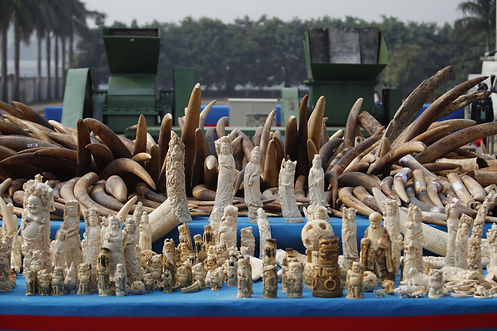
The major contributor to elephant poaching for many years now has been China. Their high demand for the material drives the ivory trade, and they are believed to be “70 percent of the global ivory demand” (Busby). Locations that are severely impacted by poaching are Mozambique and Tanzania. Their elephant populations have been rapidly declining by “14% and 17% per year, respectively” (Chase et al.). Despite having a ban on the ivory trade, there have still been many elephants poached throughout the world. Seeing as to how the ban has not stopped the demand for ivory, it calls for another solution to the issue.


A study, published in 2016, revealed that between the years 2007 to 2014, researchers estimated that about 144,000 elephants died due to poaching (Chase et al.). This number was just after the elephant population began recovering after the major drop in the 1900s, putting us back in the same spot as before. It seems that throughout history, as the elephant population begins to rise again, poaching comes back around and reverses all the progress that has been made. These innocent elephants are being killed every day for sport, for their tusks, for profit. Elephants are animals that can feel pain and suffering, yet, the humans who hunt them disregard that fact and continue to maliciously kill them without a thought. Additionally, National Geographic reports that between 2014 and 2017, about 100,000 more elephants were killed for their ivory tusks (Hall).


This has become such an issue due to the fact that if elephants become extinct, this completely alters the ecosystem. African elephants are known to be major contributors to seed dispersal all across the world. This animal “consume[s] more seeds from more species than any other taxon of large vertebrate dispersers” and as they consume the seeds, they eventually digest them out, distributing the seeds all across the lands (Campos-Arceiz & Blake). If these elephants continue to die off, important plants and trees that are vital to our earth’s balance will also disappear. Our earth, as it is, is already in danger from climate change and global warming, and by adding this on top of a long list of things affecting our world could be a tipping point. They are essential to our world because once they become endangered and, perhaps, extinct, this sets off a chain of events that can cause another species to go extinct and some plants will become invasive (Owen-Smith). Elephants also work to pave the land for smaller species to travel, maintain the flatlands and the plants from overgrowing, and provide water sources for other animals when they dig for their own water (“Why Elephants are Important”). Overall, humans are killing living, thinking, and feeling beings purely for profit. What does that say about the human race? Perhaps, we are just as “animalistic” and “uncivilized” like the animals we kill. What can we do to resolve this issue at hand?
Global Solutions
As the issues have been well established, it is crucial to work towards the preservation of the African elephant species. This is not an easy task at all and recovery will take years of work to save these animals. It is also important to be aware that, although some solutions have been enacted and proposed, this is a slow process and they may not yield the exact results that we have anticipated. Some solutions for elephant poaching have been or will be, implemented globally and some solutions focus on the issue on a smaller scale, which is called grassroots solutions.
Beginning globally, a solution that has been implemented by Congress since 1988 is the African Elephant Conservation Act (AfECA) (“U.S. Efforts to Control Illegal Elephant Ivory Trade and Internal Markets.”). This act works to put funds aside in order to save the species from extinction and they also regulate the national ivory trade. A year later after this act was passed, the U.S. Fish and Wildlife Service mentioned that they placed a “moratorium” on the importation of elephant ivory (1). This act is still going on today, in efforts to reduce the poaching of elephants. Although this large-scale solution has been implemented since the late 1900s, it is difficult to completely stop the slaughter of elephants since poachers seem to find illegal and underground ways to transport and trade their products. However, without this act, the number of elephants killed each year would rise because there would be no strict regulation of the ivory trade in our country; every act counts in this situation. Additionally, a way that the poaching issue can be resolved, or at least improved, is through the organization called World Wildlife Fund. This organization has been working closely with government agencies in the United States to try and end the trafficking of wildlife.
They are considered a solution to the issue because they have implemented is training international government officials and rangers on how to handle poaching issues and how to practice “antipoaching techniques” (“Elephant”). They also mention how they have been working with local communities to educate them on matters and how to reduce conflict between humans and animals (“Elephant”). This is one of the most effective approaches to reduce poaching because of a 2014 study called “Community Involvement and Joint Operations Aid Effective Anti-Poaching in Tanzania” by conservationist, Wayne Lotter, and training ecologist, Krissie Clark. In the research article, the authors conducted an analysis on the effectiveness of training guards and introducing anti poaching techniques. Upon reviewing the reports of the Ruvama Elephant Project, the results revealed that the guards and officers were able to seize “1,582 snares; 25,586 illegal timber (pieces); 175 elephant tusks; 805 firearms; 1, 531 rounds of ammunition” and many more threatening weapons against the elephant species (Lotter and Clark 22). By interfering with the poacher’s techniques and confiscating their tools, the guards were able to reduce the poaching in the vicinity. From this study, actively fighting against poaching through education and training is seen as the most effective solution. It yields the most results and works to eliminate poaching one step at a time.
How You Can Use Social Media as a Solution
Furthermore, as successful as global solutions are, grassroot solutions can be just as powerful. Take social media, for example, people can use these platforms to raise awareness for issues regarding elephant poaching and their endangerment. Social media is such a powerful tool and it is extremely mainstream nowadays; with one click of a button, your tweet, photo, or comment can be spread all across the world. Platforms such as Twitter or Instagram can be considered grassroot solutions because they serve to begin conversations and educate the public about how and why poaching has become a problem for the elephant species. Social media also grants individuals the ability to campaign on elephant poaching and the consequences of elephant endangerment. A successful campaign that has spoken up about poaching has been by the World Wildlife Fund (WWF) where they focused their efforts on Chinese social media and communicating platforms. The organization sent out messages on the platforms that discussed the negative impacts of poaching and the ramifications that come with taking ivory back to China (“Can we use social media to help save the elephants?”). This was effective because WWF reported that “The messages received more than 33 million views and 900,000 reposts” and it even got the attention of American celebrities (“Can we use social media to help save the elephants?”). With that many views and reposts, more individuals become educated on the matters of poaching and they also become aware of the impending endangerment of African elephants.
I, too, was privileged enough to be given an opportunity to campaign about elephant poaching on Twitter this quarter and seemed to gain the attention of some of my peers. For a whole week, my Twitter feed was full of tweets about educational sources to learn more about poaching and how it has led to elephants becoming endangered. I even included an infographic that I created in hopes of enlightening my peers on the basics of the ongoing issue. By spreading a summary of the issue, I received some responses from individuals, stating that they were unaware of the issue and how urgent it was. To educate at least one person on the topic is an extreme milestone because all things start small.

Do Your Part
All things considered, something important to ponder is, although social media can be the future for saving animals, it can also be a weapon that puts their lives at risk. According to an article written by Laura Stampler, a journalist with a graduate degree from Stanford University, geotagging on social media can lead poachers to locations of wild elephants. The article mentions that when an individual includes a geotag on their posts of themselves with wild elephants on a safari, they reveal “‘the exact co-ordinates’” of that location, “‘allowing poachers to come in after dark and track the animal’” (Stampler). To prevent elephants from being exposed to poachers, something you can do is to avoid geo tagging your posts of wild animals and spread the word about the dangerous consequences. To help with the conservation of African elephants, you can make a difference by starting conversations with those closest around you and avoid purchasing any ivory products, as it would support the businesses that poach elephants. Ultimately, restoring the elephant population will not be easy or quick, but all resolutions begin small.